Calories & Portions
Understanding calories and portions is one of the most practical skills you can build for managing your weight and energy. Learn what your daily calorie needs actually look like, how to spot high-calorie-density foods before they derail your intake, and how to measure and portion food accurately - with or without a scale.
You don't need to count every calorie to make progress. But having a clear understanding of what you're actually eating - and where the numbers come from - is one of the most effective things you can do for your health and body composition.
#Understanding & Tracking Calories
A calorie is simply a unit of energy. Your body burns a certain amount each day through basic functions, activity, and digestion - this total is your Total Daily Energy Expenditure (TDEE).
The three outcomes
| Scenario | What it means |
|---|---|
| Eat less than TDEE (deficit) | Weight loss over time |
| Match TDEE (maintenance) | Weight stays stable |
| Eat more than TDEE (surplus) | Weight gain / muscle building |
A deficit of 300-500 kcal per day is generally considered a sustainable rate of fat loss (~0.3-0.5 kg per week).
How to estimate your TDEE
Online calculators using height, weight, age, and activity level give a reasonable starting estimate. Treat it as a starting point - adjust based on how your weight responds over 2-3 weeks.
Practical tracking approaches
- App tracking (MyFitnessPal, Cronometer): most accurate, especially for a short calibration period
- Hand portions: quick field estimate without a phone
- Photo logging: builds awareness without obsessing over numbers
Even 2-3 days of accurate logging reveals patterns most people don't expect.
Where calories most often sneak in
- Cooking oils and dressings (~120 kcal per tbsp)
- Nut butter (~180 kcal per 2 tbsp)
- Alcohol (150-200 kcal per glass)
- Flavoured coffee drinks (200-400 kcal)
Liquids and cooking fats are the easiest sources to undercount.
#Calorie Density
Calorie density is the number of calories per gram of food. It explains why you can eat a large bowl of vegetables and feel light, or eat a small packet of nuts and have consumed 600 kcal.
What drives calorie density
- Water and fibre lower calorie density (fruit, vegetables, soups)
- Fat raises calorie density significantly (oils, nuts, cheese)
- Protein and carbs land in the middle (~4 kcal/g each vs 9 kcal/g for fat)
The spectrum
| Density | Range | Examples |
|---|---|---|
| Low | <100 kcal / 100g | Leafy veg, cucumber, berries, broth soups |
| Medium | 100-300 kcal / 100g | Lean meat, fish, cooked grains, legumes |
| High | >400 kcal / 100g | Oils, nuts, cheese, pastries, chocolate |
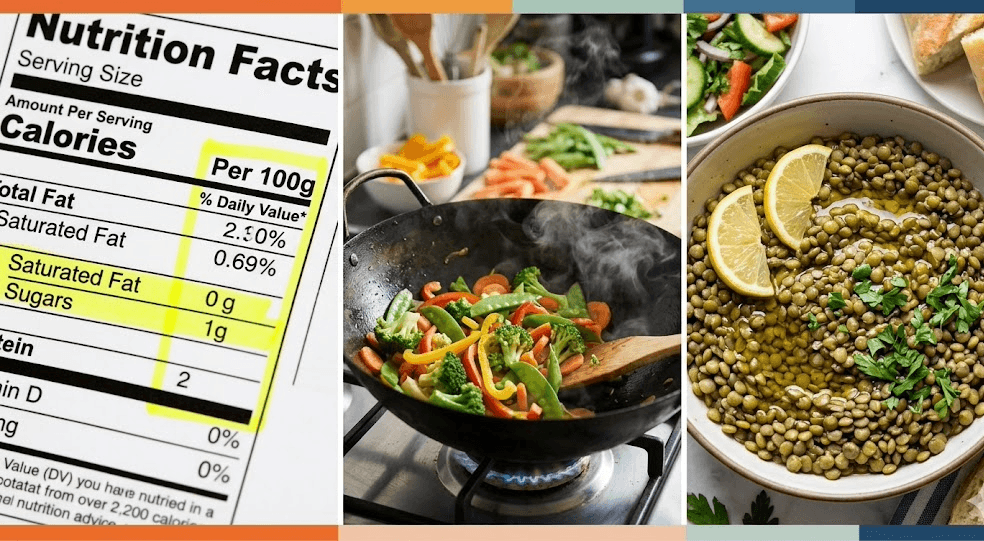
Quick label scan
Check per 100g on the nutrition panel: under 100 kcal = low density; over 400 kcal = high density. Takes 5 seconds at the supermarket.
The volume eating approach
Filling half your plate with low-density foods first (vegetables, salad, broth soup) means you get more food volume, feel fuller, and naturally consume fewer calories - without tracking every gram.
#Weighing & Portioning Food
Eyeballing portions is notoriously unreliable. Research consistently shows people underestimate calorie intake by 20-40%, particularly for calorie-dense foods like oils, nut butters, cereals, and cheese.
The most common over-poured foods
- Oil: a casual drizzle is often 2-3 tbsp (240-360 kcal vs ~120 kcal for 1 tbsp)
- Nut butter: a heaped spoon is typically 3-4 tbsp (270-360 kcal)
- Cereal: a "bowl" is usually 2-3× the stated serving size
- Cheese: a casual slice is often 50-80g (200-320 kcal)
Cooked vs raw weight
This catches people out regularly:
- Rice: roughly doubles in weight when cooked
- Pasta: roughly triples in weight when cooked
- Meat: shrinks ~25% when cooked
Weigh rice and pasta dry before cooking, or use a cooked weight database entry - not both.
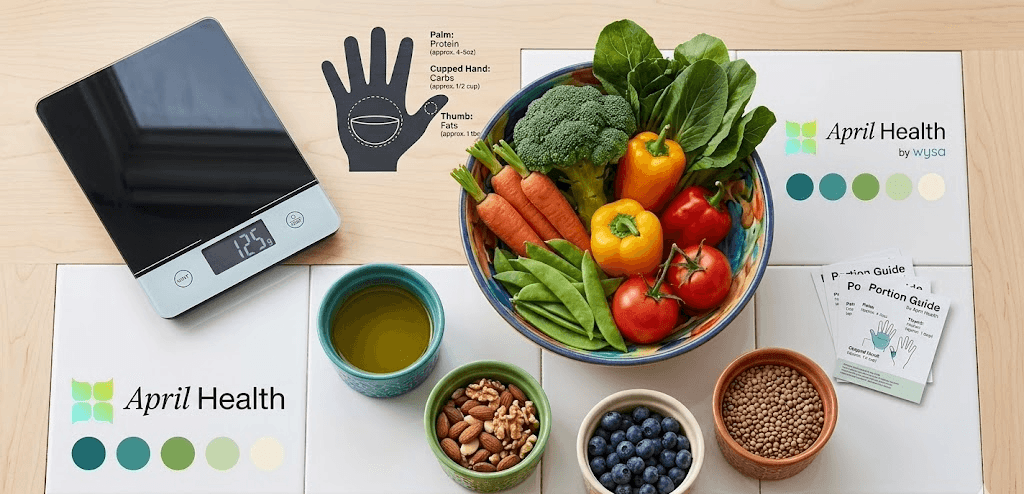
Hand anchors (when you can't weigh)
- Palm ≈ 25-30g protein (chicken, fish, beef)
- Fist ≈ 1 cup cooked veg or grain
- Thumb ≈ 1 tbsp fat (oil, nut butter, butter)
- Cupped hand ≈ 30g nuts or dried fruit
Scale tips
- Weigh before cooking where possible
- Use grams, not cups - cups vary by how packed the food is
- Tare (zero) between each ingredient when building a meal
Short-term effort, long-term benefit
Accurately measuring for 1-2 weeks recalibrates your visual estimates for months afterward.
Enjoyed this guide? Share it with others.
More from the blog
Continue your learning journey with these guides.