Food Choices & Preparation
Getting more from the food you already eat starts with three habits: reading labels without being deceived, choosing cooking methods that preserve nutrients, and pairing foods in ways that improve absorption. This how-to covers all three - practical knowledge you can apply at the supermarket, in the kitchen, and at every meal.
How much nutrition you actually get from food depends on more than just what you buy. How you read labels at the supermarket, how you cook at home, and how you combine foods at each meal all make a meaningful difference to what ends up nourishing your body.
#Reading Nutrition Labels
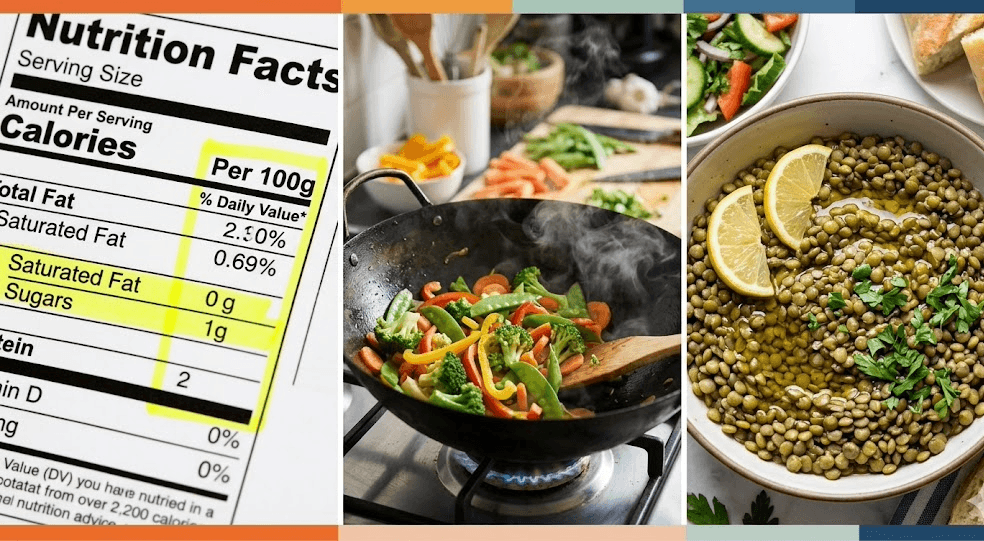
Nutrition labels contain everything you need to make an informed food choice - but they're laid out in ways that make it easy to miss what matters.
Trap 1: Serving size
A label showing 150 kcal per serving can be misleading if the "serving" is half the packet. Always check how many servings the container contains and multiply accordingly.
Per 100g is your comparison baseline
Ignore the front-of-pack claims. Flip to the back and compare per 100g across products - it's the only like-for-like comparison.
Ingredients list: order = quantity
Ingredients are listed by weight, largest first. If sugar, oil, or salt appears in the first three ingredients, the product is built around it. Shorter lists with recognisable ingredients are generally a better sign.
Key thresholds per 100g (UK traffic light)
| Nutrient | Low (green) | High (red) |
|---|---|---|
| Saturated fat | <1.5g | >5g |
| Total sugars | <5g | >22.5g |
| Salt | <0.3g | >1.5g |
30-second scan at the supermarket
- Check the serving size - is it realistic for how you'd actually eat it?
- Compare per 100g with an alternative
- Scan the first 3 ingredients
- Check saturated fat and salt against the thresholds above
#Cooking Methods That Preserve Nutrients
How you cook matters as much as what you cook. Heat, water, and time all affect the nutrient content that makes it to your plate.
What degrades nutrients
- Water: leaches water-soluble vitamins (C, B vitamins) out of food into cooking liquid
- High heat: degrades heat-sensitive vitamins (C, folate, B1)
- Long cook times: more exposure = more cumulative loss
- Oxygen: oxidises fat-soluble vitamins, especially in cut or grated food left sitting
Method comparison
| Method | Nutrient retention | Notes |
|---|---|---|
| Steaming | Excellent | Best for most vegetables |
| Microwaving | Very good | Short time, minimal water |
| Stir-frying | Good | High heat is brief |
| Boiling | Moderate | Vitamins leach into water |
| Deep frying | Poor | Adds fat, degrades some nutrients |
| Raw | Best (for some) | Ideal for vitamin C; not safe for all foods |
If you do boil - use the water
The cooking water from boiled vegetables contains leached vitamins and minerals. Use it as a base for soups or sauces instead of discarding it.
Simple habits
- Keep skins on where possible - fibre and many nutrients sit just beneath the skin
- Cut vegetables close to cooking time to limit oxidation
- Aim for tender-crisp rather than soft - less cooking = more nutrients retained
- Use olive oil at low to medium heat
#Improving Nutrient Absorption
Eating nutritious food is only half the equation. Whether your body actually absorbs those nutrients depends on what you pair foods with, how you prepare them, and the health of your gut.
Fat-soluble vitamins need fat
Vitamins A, D, E, and K require dietary fat to be absorbed. A fat-free salad dressing means most of the fat-soluble vitamins in your salad pass through unabsorbed. Adding even a small amount of olive oil or avocado makes a significant difference.
Iron + vitamin C
Plant-based (non-haem) iron is absorbed at a much lower rate than animal iron - but pairing it with vitamin C can increase absorption by up to 3×:
- Lentils or beans + squeeze of lemon juice
- Spinach + red or yellow pepper
- Iron-fortified cereal + orange juice (not apple juice - lower in vitamin C)
What blocks absorption
- Tea and coffee: tannins bind to iron and inhibit absorption - wait at least an hour after an iron-rich meal before drinking them
- Phytates: found in raw legumes and wholegrains; bind minerals like iron, zinc, and calcium
- Calcium and iron compete for absorption - avoid taking both supplements simultaneously
Reducing anti-nutrients
- Soak legumes for 8-12 hours before cooking - reduces phytates by around 50%
- Fermented foods (yoghurt, kefir, sourdough, tempeh) have improved bioavailability and support the gut bacteria that aid nutrient absorption
Enjoyed this guide? Share it with others.
More from the blog
Continue your learning journey with these guides.